
An ancestral tablet and a columbarium niche can be planned together, but they do different jobs. The niche is the place associated with an urn containing cremated remains. The tablet is a memorial inscription used in remembrance. If a family wants both, the useful question is how the two arrangements will support its visits and traditions, rather than whether one automatically replaces the other.
At Nirvana Singapore, families can explore columbarium arrangements and ancestral tablets within the same broader planning conversation. That makes it easier to see the relationship between the services. Each still needs a clear description, an agreed purpose and its own relevant terms.
Ancestral tablet and columbarium niche: two parts of one family conversation
Confusion often begins with the phrase “a place for our parents.” One child may mean a compartment for two urns. Another may mean an ancestral pedestal where the family can pay respects. A third may be thinking about the funeral itself. All three are discussing remembrance, yet they have not necessarily agreed on the same service.
Use plain descriptions at the start. Say whether the family needs an urn placement now, a tablet arrangement, or planning for a future need. Explain whether there is an existing niche or home altar. These details help the conversation begin with the actual circumstances instead of a broad package description that different relatives interpret differently.
- Columbarium niche
- A compartment associated with placing an urn. Capacity, dimensions, inscription and placement procedures belong to the specific arrangement.
- Ancestral tablet or pedestal
- A dedicated memorial inscription and setting for remembrance. Name format, display, religious context and care should be explained for the selected option.
- Prayer service
- An organised observance that may be discussed alongside either arrangement. Timing, format and inclusion require their own explanation.
These distinctions do not make the plan more complicated. They prevent a family from discovering later that one important part was never discussed. A clear service conversation gives relatives a way to explain their choice to someone who could not attend the viewing.
An urn niche solves a placement need
If cremated remains need a place, the niche discussion has practical details that a tablet cannot answer. The urn needs to be suitable for the actual compartment, and the family needs to understand the placement process. We can discuss the urn niche options in relation to the placement your family needs. Measurements and capacity should come from the selected arrangement rather than an assumption based on appearance.
A family arranging an immediate placement may need to focus first on the niche and the relevant documents and appointments. It can still discuss a tablet, but the two decisions need not be rushed into a single approval. Identify what is time-sensitive and what can be considered after relatives have had time to understand the options.
An ancestral pedestal gives remembrance its own setting
A tablet can provide a named place for a family’s remembrance beyond a private household. Lin San Temple has ancestral pedestal areas, a niche suite and Mini Buddha displays within its Buddhist setting. That gives families an opportunity to view different memorial features within a temple setting while recognising their distinct purposes.
The value of the pedestal may be its connection with a family’s tradition, its shared location or the opportunity for several households to visit. Explain which of those matters most. If the family mainly needs somewhere for an urn, a beautiful tablet display does not settle the ash-placement question. If it wants a tablet for ancestors, a niche alone may not represent the intended arrangement.
Private prayers are a service choice, not an automatic feature
Our prayer services include private arrangements and occasions such as Qing Ming, Vesak Day and Double Ninth. These can support a family’s religious observances where appropriate. The relevant venue, format and booking should be discussed specifically rather than inferred from the presence of a pedestal or niche.
One family may want a quiet personal visit most of the year and an organised observance on a particular occasion. Another may want religious guidance around a new placement. Describing the intended observance helps the adviser explain the relevant service, instead of leaving the family to assume every ceremony is included in an initial payment.
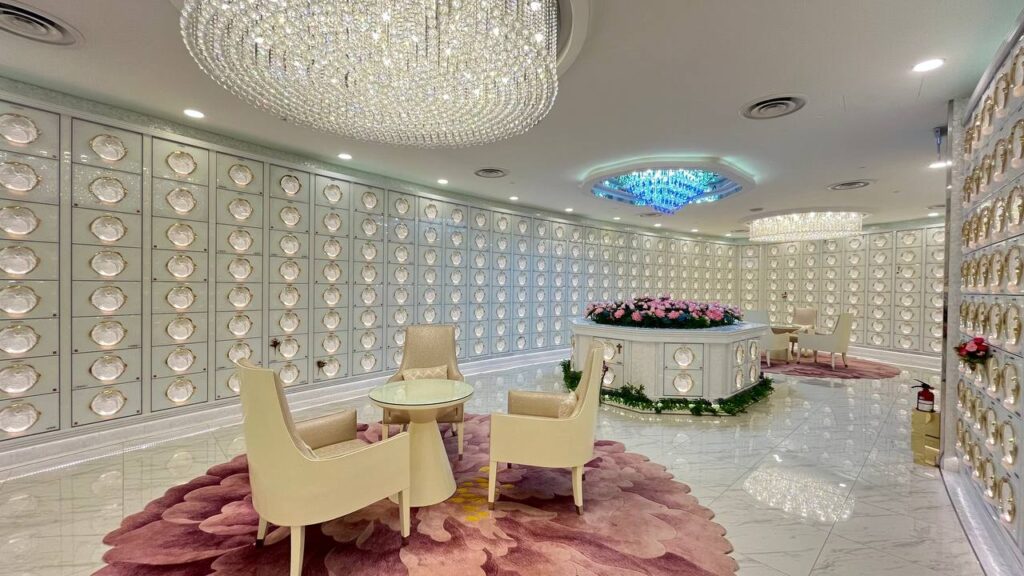
Planning the tablet and niche together can make family visits clearer
When relatives hope to visit both arrangements during one outing, location becomes part of the service choice. Look at the actual pedestal and niche areas, not merely the overall venue name. A shared venue can be convenient, but the family still needs to understand the route, current access arrangements and what each stop involves.
Nirvana Memorial Garden has Blocks A, B and C, with different suite settings to explore. That range gives families more than one visual environment to consider. It also makes specificity important. A photograph from one block should not be used to describe an arrangement in another, and a preferred suite should be identified before the family assumes a particular visiting experience.
Picture a family visiting with an older parent and two children. They may appreciate a straightforward route between the places they want to visit, room to pause and a clear explanation of each memorial. An attractive overall complex matters, but so does the small sequence of walking, standing and gathering that makes an ordinary visit comfortable.
For relatives with different religious practices, discuss what happens at each stop. Someone may wish to stand quietly at the tablet and then accompany the family to the niche. Another relative may participate in a prayer service. Agreeing the approach beforehand allows respectful participation without asking everyone to express remembrance identically.
Two family situations show why tablet and niche plans should stay distinct
Consider adult children whose parents already have an urn niche, while the family tablet remains in a home that is about to be sold. Their immediate question concerns the tablet’s future setting. The existing niche does not necessarily need to move. A pedestal discussion can address shared access and the family’s tradition without turning the housing change into a new urn-placement decision.
For this family, the useful viewing focuses on the actual ancestral pedestal, the names it can accommodate and the practical arrangements for future visits. If they want both memorials in one place, that becomes a separate comparison. They should understand the implications of any proposed change rather than assume that togetherness always requires moving everything.
Now consider a couple planning ahead who have not arranged either service. They may want a place for their future urns and also want to understand how their children will continue ancestral remembrance. A combined planning conversation is useful because it can show the different services side by side. It should explain each decision instead of treating the family’s uncertainty as permission to select every option.
In this second situation, the children need a clear account of what has been chosen and what has not. They should know whether the plan concerns a niche, a tablet, funeral services or some combination. A family record that uses those precise names is more helpful than a message saying “everything is settled” when several elements remain open.
Religious continuity does not mean every family needs the same combination
Some families see tablet remembrance as central to their practice. Others place greater emphasis on visiting the niche, or observe remembrance in another way. A suitable service discussion respects that difference. It should explain the available options without suggesting that devotion can be measured by the number of arrangements selected.
The Singapore Chinese Cultural Centre’s Qing Ming overview offers background on local remembrance traditions. It is useful context for understanding why a family may value a shared memorial place. It does not establish that every family must choose both a tablet and a niche or follow identical rites.
For specific questions about religious meaning, discuss the family’s practice with the appropriate adviser. A temple setting may feel familiar to one generation and unfamiliar to another. Give younger relatives space to ask what the tablet represents and why it is distinct from the urn. A simple explanation can make future visits more meaningful than an elaborate ceremony nobody understands.
Our service approach allows the environment, the memorial arrangement and the family’s preferences to be discussed together. The benefit is a more understandable choice, not a claim that one configuration suits everyone. Tell the adviser what you want to preserve and what practical difficulty you hope the arrangement will solve.
Read a combined proposal as separate service decisions
When a proposal includes a tablet and a niche, identify each item clearly. The niche location, urn capacity and placement requirements should be understandable on their own. The tablet format, intended names and associated care should also be clear. Any prayer service or additional feature should be named rather than hidden inside a general description.
Look at the costs and ongoing obligations for each part. A term used to describe one arrangement may not explain the other. If a phrase about tenure, maintenance or future changes is unclear, ask for the relevant provision to be explained in ordinary language. Retain the actual written terms with the final family record.
Keep inscription approvals separate, too. A proof for the niche should not be assumed to approve the tablet’s wording. Check names against the agreed reference for each memorial. If the family wants a particular name or photograph format, establish that it is available in the selected arrangement before treating the layout as settled.
Practical clarity is a form of care for the relatives who will manage the arrangements later. They should be able to find the correct location, understand which service has been arranged and know where to obtain current visiting information. A plan that can be explained in plain language is easier to continue.
The tablet and urn may commemorate different parts of the family
A family discussion can involve a tablet for ancestors across generations and a niche for one recently deceased relative. In that situation, the names, visiting purpose and people involved may differ. Explain the intended scope of each arrangement before comparing options. A tablet should not be treated as a duplicate of the niche simply because both appear in one conversation.
That distinction can help younger relatives understand a family visit. At the niche, they may be remembering a grandparent they knew personally. At the tablet, an older relative may explain names belonging to earlier generations. A dedicated memorial setting gives those conversations a place, while the family’s own stories make the relationships understandable.
If the family chooses both, record the precise locations separately and explain which person or ancestors each arrangement remembers. Relatives who visit independently should not have to guess which area is intended. A clear private note can include the route and the relevant current contact, without circulating other families’ inscriptions or assuming photographs are always permitted.
The benefit of coordinated planning is this practical connection between services and family use. It lets the arrangement reflect a real pattern of remembrance. It also allows a family to see when a second service adds meaning and when it would merely duplicate a decision that has already been made in another way.
Choose the tablet-and-niche combination the family will genuinely use
Before deciding, ask the family to describe an ordinary future visit. Where will people go? Who will be remembered at each place? Will a religious service be part of that visit or arranged separately? The answers reveal whether the proposed combination supports the family’s actual intentions.
If only one service is needed now, it is reasonable to focus on it. If both fit the family’s wishes, view the relevant settings and make each decision clear. The tablet and columbarium niche can complement one another when relatives understand their different roles. Their value lies in the family’s continuing connection with the people remembered, supported by arrangements that are specific, accessible and properly understood.