
Moving cremated remains to another niche is a decision about a new remembrance place and a coordinated change to an existing arrangement. Choose the destination only after understanding the current location’s requirements, the receiving venue’s requirements and who can authorise the move. Do not book a transfer date on the assumption that arranging a new niche automatically releases the old one.
Families considering our private columbarium options may be looking for a different setting, a location that suits regular visits or a way to remember relatives closer together. Those are understandable reasons to explore a change. The move still needs to be discussed specifically with the relevant operators; there is no single procedure that should be assumed to apply to every starting point.
A niche transfer starts with the reason your family wants a different place
Be clear about the problem the move is meant to solve. Perhaps a surviving spouse now finds the journey difficult. Perhaps several relatives want a shared venue, or the family wants a setting that better fits its current remembrance practice. Naming the reason helps the adviser identify suitable options and keeps the conversation focused on the family’s real need.
Changing a memorial place can feel significant even when the practical reasons are straightforward. Some relatives may feel attached to the existing location because it is part of their visiting routine. Give that attachment room in the discussion. A more convenient destination may be valuable, but it is easier to agree on when the family understands what is being gained and what is changing.
A move for easier visits should be tested through an actual visit
If convenience is the main reason, assess the proposed journey with the regular visitor in mind. Look at arrival, the route to the room and the niche position. A new venue should answer the difficulty that prompted the move, rather than simply offer an attractive different room.
A family whose older parent needs accompaniment may find a location easier for several children to help with. Another family may want a dedicated destination for planned gatherings. These are different visiting patterns. The destination should suit the pattern the family expects to sustain after the move, not only the group present during the viewing.
A shared family arrangement needs a clear list of intended placements
If several urns may be brought together, identify them separately and establish which moves are actually being considered. A wish to remember everyone in one place does not mean every relative has agreed to move an existing urn. The family can explore a shared destination while respecting individual arrangements that remain unchanged.
Our single, double and larger niche formats offer different starting points for that discussion. The actual configuration must suit the intended containers and placements. A general capacity description should not replace a specific plan for the urns the family wishes to bring.
The existing niche and receiving niche have separate requirements
The current operator needs to explain the requirements for release, removal or any change to the existing arrangement. The receiving operator needs to explain acceptance and placement at the destination. Ask the professionals involved to distinguish their responsibilities. An assurance about one side of the move cannot answer a question belonging to the other.
For government-managed niches, refer directly to NEA. Its e-services information distinguishes recent-death niche applications from transfer situations. That is a reason to seek the correct route for your circumstances, rather than treating a transfer as an ordinary new application. Private venues may have their own documentation and authorisation arrangements.
Identify who is authorised before discussing a transfer date
The person organising family messages may not be the person authorised to give instructions about the current niche. Ask the current operator what is required and who must participate. If the original applicant is unavailable or circumstances have changed, obtain an explanation of the appropriate process rather than making an informal substitute.
If authority is unclear, settle that question with the current operator before fixing a transfer date. The person arranging a new niche may still need another person’s participation or specific documents for the existing arrangement. Give the receiving team an accurate update so its placement planning follows the confirmed position rather than an assumption made in a family conversation.
The urn must be suitable for the receiving compartment
Keep the existing container in the destination discussion from the beginning. Its complete external measurements, shape and intended orientation matter. Ask how the urn fits the actual compartment and opening. A single or double label does not guarantee compatibility with every existing container.
If the family wants to retain a meaningful urn, say so before selecting a niche. A different configuration may be more suitable than altering the container. Any proposed handling or change should be explained by the appropriate professional, with the family’s wishes understood. Avoid treating the urn as something that can simply be adjusted later.
Nirvana Memorial Garden can offer a different kind of remembrance visit
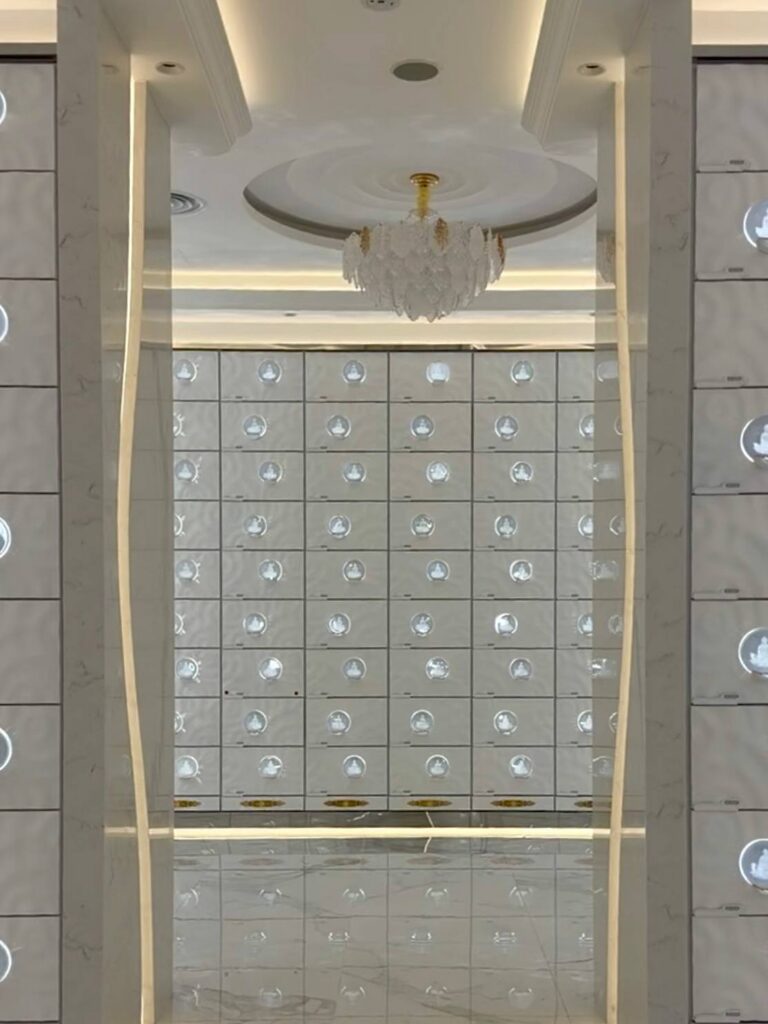
For a family exploring a dedicated memorial environment, Nirvana Memorial Garden combines traditional and modern architecture with greenery in western Singapore. Its different blocks and suite settings allow a family to consider the surroundings as well as the compartment. The move may be worthwhile when that setting genuinely supports the visits the family wants.
If the move is intended to make visits easier, consider how Nirvana’s air-conditioned memorial halls, digital directories and family lounges would address the difficulty at the present location. A relative who knows the former niche well will need a new room reference; an older spouse may value a comfortable place to pause. View those facilities in relation to the receiving suite before treating the new setting as an improvement.
A transfer may also reflect a change in the setting the family wants to visit. Nirvana’s religious and free-thinker rooms provide different surroundings to explore. Discuss why the current room no longer fits, then see whether the proposed destination addresses that concern. The change should follow the family’s wishes for remembrance, alongside the practical arrangements for the urn.
A new place should not be presented as more respectful simply because it is new or more elaborate. The existing location may have served the family well. The useful question is whether the proposed destination suits the family’s circumstances now, with a clear understanding of the practical change.
A temple niche transfer needs a destination-specific service discussion
A transfer to Lin San Temple would place the new niche within a Buddhist temple environment; Thian Leng Temple provides another temple destination to explore in the Kembangan area. If that connection is part of the reason for moving, view the relevant space before coordinating the change. The family needs to recognise the new place as well as understand how the urn arrives there.
Do not assume that choosing a temple means the entire transfer and remembrance arrangement is already defined. The destination niche, any related service and the proposed observance need their own explanation. The family may wish for a simple placement, a religious arrangement or a separate ancestral-pedestal discussion. Those are related choices with different purposes.
For a family with existing ancestral remembrance practices, discuss how a move would fit that practice. A niche holds cremated remains; a pedestal is a different remembrance element. Moving an urn does not automatically require the family to add or change a pedestal. Any additional arrangement should follow an understood preference.
Build the niche-transfer date around confirmed arrangements
Once a suitable destination is identified, establish what must happen before a date can be agreed. The current operator, receiving venue and any professional handling the move need compatible information. A family should know which part of the plan is confirmed and which remains conditional.
Ask who will coordinate the handover and how the urn will be identified throughout the arrangement. The responsible professionals should explain their process without expecting the family to improvise handling. If a religious observance is desired, discuss its timing alongside the placement rather than adding it after the practical schedule has been fixed.
Relatives attending from overseas may create a preferred date, but travel plans should not be mistaken for confirmation that every transfer requirement has been met. Explain the family constraint early and ask what can realistically be arranged. It is better to understand a dependency than to discover it after tickets or family leave have been organised.
Where several urns are involved, it may not be appropriate to assume they can all move together. Their starting locations, authorisations or intended arrangements may differ. A clear explanation for each placement can keep a shared family intention from becoming an unnecessarily complicated single deadline.
The new inscription deserves attention before the move
The family may wish to retain the same names, photograph or wording at the destination. Check what the proposed niche face permits and how the new design will be approved. An existing memorial face is not automatically transferable to a different compartment or suite.
Review the complete proof rather than relying on the old inscription being copied correctly. Confirm names and dates, and discuss any change in language or presentation. For a double or larger arrangement, establish how each person is represented. A move offers an opportunity to clarify the design, but it should not create an unannounced change to a detail important to the family.
Ask what happens to the previous memorial face and any personal items under the current operator’s arrangements. Do not assume that everything visible at the existing niche will accompany the urn. Knowing what will be retained, returned or dealt with by the operator can prevent a painful misunderstanding on the day.
Discuss the full cost of the change, not only the destination niche
A transfer can involve more than selecting a new compartment. Ask which work belongs to the existing arrangement, which belongs to the receiving venue and which is provided by another professional. The quotation should make those boundaries understandable. Avoid assuming a promotion or a general service description includes every part of a move from any starting location.
For example, a family may understand the destination niche price while still needing the scope of removal, handling, memorial-face work or a chosen religious observance explained. The actual proposal should identify which of those items are included, optional or separately arranged for this move. That gives the family a complete cost discussion without relying on a general description of transfer services.
Also ask whether anything about the former arrangement needs to be closed or surrendered and what effect that has under its terms. The current operator should explain that aspect. A new purchase does not, on its own, tell the family what happens to its previous arrangement. Keeping the two explanations distinct helps everyone see the complete decision.
Let the first visit to the new niche feel familiar
Before the move, show the regular visitors the destination where practical. Explain the route and the exact niche reference. An older relative who knows only the former location may benefit from a calm introduction to the new place, without simultaneously being asked to follow a complex transfer discussion.
After placement, leave time for the family to be present in its own way within the venue’s arrangements. Some may want prayer; others may prefer quiet conversation or a moment of reflection. The new location becomes part of family life through those visits, rather than through the administrative move alone.
A considered transfer joins a practical improvement to a respectful transition. Choose a destination for clear reasons, let the relevant operators settle their requirements and make sure the people who will return understand the new place. The family should arrive knowing why it chose the setting and how remembrance can continue there.