
A parent may have been a practising Buddhist while their children follow different faiths, or none. Buddhist funeral planning in Singapore can still be thoughtful and coherent. Start by identifying the deceased’s wishes, then ask which prayers and ceremonies will express those wishes and how each relative can participate comfortably. Everyone does not need the same beliefs to offer a respectful farewell.
It helps to discuss the funeral and the later memorial arrangements separately. A Buddhist farewell does not, by itself, settle the family’s choice of niche suite, ancestral pedestal or future prayer schedule. Our funeral support service provides a starting point for immediate arrangements, while its memorial and prayer information allows the longer-term choices to receive their own attention.
Let the deceased’s Buddhist wishes shape the funeral brief
The most useful starting point is a remembered or written wish that belongs to the person being honoured. Perhaps a mother attended temple regularly but asked for a modest farewell. Perhaps a father wanted Buddhist prayers but never discussed the length of the wake. Those details help the family explain the situation without assuming that one religious label answers every question.
Write down what is known and what is uncertain. A precise memory such as wanting a particular prayer is different from a relative’s belief that it would be customary. Both may deserve discussion, but they should not be presented to the coordinator as equally definite instructions. This makes it easier to seek clarification before arrangements become difficult to change.
Buddhist funeral prayers need an agreed explanation
Ask for the proposed prayer arrangements to be described in ordinary language. Which parts will be led by a practitioner? What will family members be invited to do? When should relatives be present? A person who has not attended a Buddhist funeral before should be able to understand the practical flow without pretending to know the customs.
The explanation should come from the person responsible for the religious service. A general article cannot prescribe a single correct sequence for all Buddhist families or traditions. Our existing introduction to Buddhist funerals can help relatives become familiar with the subject, but the family’s actual arrangements still need individual confirmation.
Where a parent had a relationship with a particular temple or practitioner, mention it early. Ask whether and how that preference can be accommodated. Do not assume the funeral service includes that person, or that any practitioner can simply replace another. A clear conversation about roles protects the family’s wishes and avoids last-minute confusion.
Different family beliefs do not need to become competing funeral plans
A common difficulty is that relatives discuss participation and the funeral’s religious identity as though they are the same question. They are related, but can be considered separately. The farewell may honour the deceased’s Buddhist wishes while individual relatives ask what respectful attendance can look like for them.
For example, a daughter who does not share her father’s religion may still wish to sit with the family, receive visitors and help organise transport. Another relative may wish to take part in every prayer. Discuss these preferences with sensitivity, and ask the relevant practitioner to explain any expectations. Avoid making either person speak for an entire religion.
Explain chanting and ceremonial participation before the wake
Relatives should not have to discover in front of visitors that they are uncertain about a ceremonial action. A quiet advance explanation gives them room to ask questions. Find out which moments involve the immediate family, what guidance will be offered and whom they can approach if they need clarification.
This is especially useful when younger family members recognise some customs but do not know their meaning. Rather than telling them to copy everyone else, explain what the family has agreed to do. Clear guidance can reduce the pressure on an older relative who might otherwise be expected to coach everyone while grieving.
Keep Buddhist and Taoist observances distinct in the service discussion
Some families use broad phrases for customs that come from different traditions. If relatives request a ceremony, ask them to describe it rather than rely on a label. Then confirm its meaning and suitability with the practitioner. Mixing familiar elements by assumption can leave the family with a service that nobody clearly intended.
Our article on Buddhism and Taoism is a useful reminder to ask questions rather than treat the traditions as interchangeable. The purpose of that discussion is understanding. It should not be used to tell another relative that their family memories are invalid or to impose a correction during the wake.
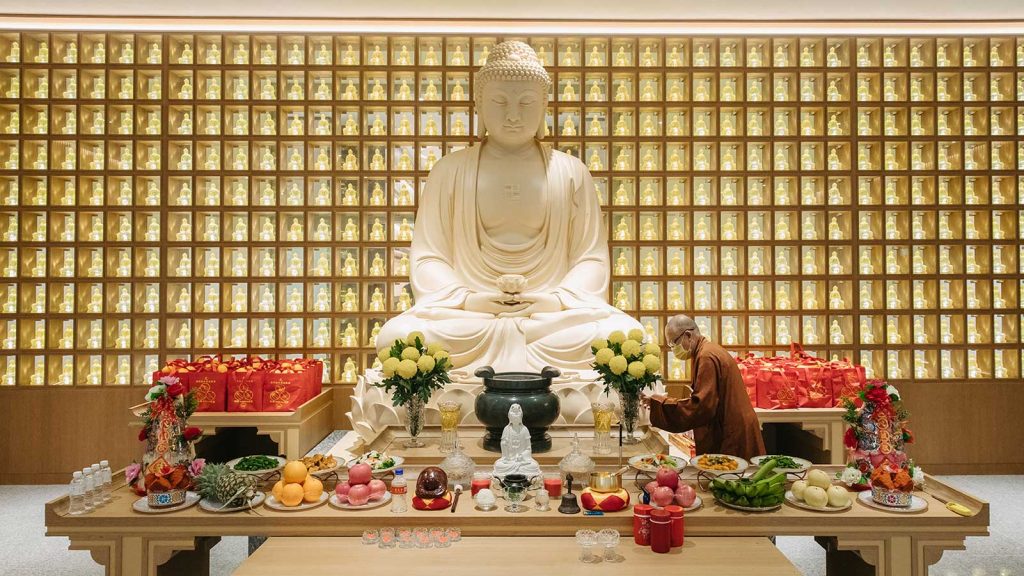
A Buddhist funeral proposal should describe the family’s actual arrangements
Once the religious direction is clear, connect it to the proposed service. Ask how the prayers, wake arrangements and final farewell fit together. Identify what the proposal includes and what would require a separate arrangement. Families can then compare the written scope with their wishes rather than rely on a reassuring description of an all-inclusive service.
NEA’s funeral guidance recognises that services vary with religious requirements and family preferences. That is a sound reason to seek an individual explanation of the proposed arrangement. The word Buddhist should introduce the discussion, not end it.
Consider a family whose older relatives prefer a fuller period of observance, while the immediate household has limited help. They need to discuss the available service options, who will be present and what work remains with the family. The practical arrangement should support the agreed farewell. It should not depend on relatives quietly taking on tasks they cannot manage.
Another family may prefer a small farewell followed by a private remembrance gathering. Ask whether the funeral arrangement and the later prayer service can be explained as separate parts, with their own scope and timing. We offer customised private prayer services. Suitability, availability and the relevant religious arrangements need to be confirmed for the family’s request.
Ask who will guide relatives through the Buddhist farewell
There is a practical difference between having a religious service on the schedule and knowing who will explain it to the family. Ask who gives the instructions, which language will be used and how relatives can raise a question. Do not assume that every person involved in the funeral has the same responsibility for religious guidance.
If relatives need an explanation in different languages, mention that before the service is finalised. Ask what can be arranged rather than promise a translation to the family. A simple explanation given at the right time may be more helpful than a long document nobody has had the opportunity to read.
Choose the memorial setting with the people who will return to it
After the farewell, relatives may continue to remember the deceased in different ways. Some will value a Buddhist temple setting. Others may be more concerned with the journey, the indoor environment or the possibility of visiting together. These are legitimate matters to discuss when choosing a niche, even where the funeral’s religious direction is already settled.
Our columbarium information presents a range of settings and describes options for different beliefs. Nirvana Memorial Garden has three blocks with various suites at Old Choa Chu Kang Road. That gives the family more to compare than a single photograph of a niche door. Ask to understand the atmosphere, the position offered and the terms for that exact selection.
For relatives who value a temple environment, Lin San Temple offers a Buddhist setting with niche suites and ancestral pedestals. A visit can help the family decide whether that environment feels suitable for future remembrance. Our description of freehold should lead to questions about the actual agreement and applicable fees; it should not be turned into an assumption about every future obligation.
A niche and an ancestral pedestal answer different remembrance needs
A niche provides a place for cremated remains. An ancestral pedestal serves a different commemorative and religious purpose. A family might want one, both, or more time to understand the distinction. Ask how the proposed arrangement relates to the family’s own practices instead of assuming a Buddhist funeral automatically requires every memorial option.
Where siblings have different beliefs, clarify who expects to attend later observances and who will keep the relevant details. This is a conversation about practical continuity, not a demand for identical participation. A shared record of the venue, agreement and service contact can help everyone remain informed even if they visit in different ways.
Agree on later Buddhist remembrance without making promises for others
Future prayer arrangements deserve the same care as the funeral itself. We offer observances including Vesak Day as well as private prayer services. Ask which arrangements relate to the selected venue, how current schedules are communicated and what the family would need to request separately. An event described online should not be assumed to be included in a particular purchase.
Be realistic about who will attend. One sibling may live abroad; another may be able to visit frequently. The family can record a wish for remembrance without promising attendance on behalf of people whose circumstances are uncertain. Discuss how updates will be shared and who will retain the service information.
If the discussion becomes tense, return to a concrete question. Are relatives disagreeing about the deceased’s wishes, about an action expected of them, or about the future memorial setting? These require different answers. A service coordinator can help explain options, while a religious practitioner can clarify ritual matters. Neither conversation needs to become a judgment about the family’s affection for the person who died.
Before confirming the arrangement, read the religious description alongside the practical service scope. Check that the agreed prayers are described accurately, that relatives know what participation means and that any later memorial choices are recorded separately. Ask for unclear wording to be explained while there is still time to resolve it calmly.
Coordinated help is particularly valuable when the family is considering more than the ceremony. Ada, our service director, assists families with preplanning. That gives relatives a named starting point for a conversation covering funeral arrangements, niche options and ancestral remembrance. They can explain the family situation once, then work through the distinct decisions with a clearer sense of how the services relate.
For a mixed-belief household, that breadth matters in an ordinary, practical way. The family may be comfortable with Buddhist prayers for the funeral but still undecided between a temple niche and another memorial suite. Seeing those options discussed within the same service offering allows the religious farewell and the future visiting environment to be considered together. It avoids assuming that the most meaningful ceremony must determine every later choice.
The memorial garden’s combination of traditional architectural influences and modern indoor comforts can also be relevant to this discussion. Older relatives may connect with the familiar religious setting, while younger visitors notice whether they can spend time together comfortably. The value lies in finding a place the family can use for remembrance, not in persuading everyone to experience that place in exactly the same way. A viewing and a clear explanation of the chosen suite make those preferences tangible.
A considerate Buddhist farewell can make space for a family’s differences while remaining faithful to the person being honoured. Choose the prayers deliberately, explain them gently and leave relatives room to show their care in ways they understand. That gives the family something more useful than a forced agreement: a farewell they can carry out with clarity and respect.